SET THE LOWER CHOPSTICK
Rest it between the base of your thumb and the side of your ring finger. This is the stable rail—do not squeeze it or try to move it.
KOREAN TABLE CULTURE · 01
The simplest secret to Korean chopsticks is not stronger fingers. It is giving each finger one clear job.
SEE THE FOUR STEPS ↓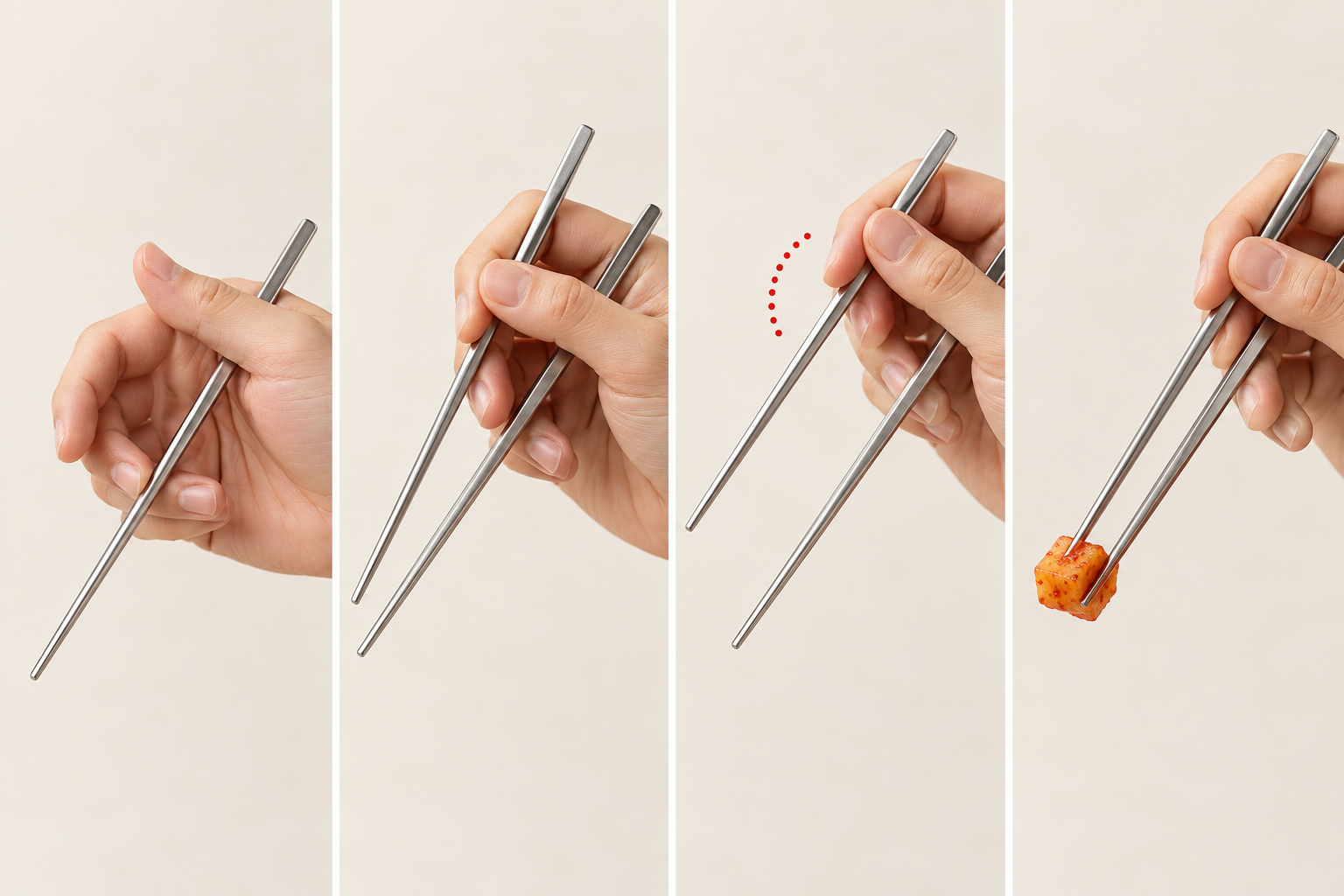
FOLLOW THE HAND
Start slowly with the sticks aligned. Speed arrives after the movement becomes small and repeatable.
Rest it between the base of your thumb and the side of your ring finger. This is the stable rail—do not squeeze it or try to move it.
Use your thumb, index finger and middle finger. Keep the grip about one-third of the way down from the top.
Your index and middle fingers open and close the upper stick. The lower stick stays quiet, giving every movement a fixed target.
Line up both tips before you pick food up. Use light pressure—accuracy comes from alignment, not from gripping harder.
WHY THIS GRIP WORKS
The lower chopstick becomes a fixed reference point, so your whole hand does not have to chase the food.
Only the index and middle fingers guide the upper stick. A smaller motion is easier to repeat accurately.
Both tips return to the same meeting point. Once your hand remembers that path, control becomes faster and more natural.
Correct support reduces the urge to pinch hard—especially helpful with thin, flat Korean metal chopsticks.
FROM OLD TABLES TO TODAY
Korean lacquerwork has an ancient history, and fine lacquered wooden tableware became valued household craft. Surviving Goryeo finds also show spoons and chopsticks made from metals such as silver and copper alloys. Today, stainless steel is the everyday standard in many homes.
Cultural references: National Museum of Korea and Korea.net.
KOREAN TABLE MYTH?
Koreans sometimes joke that frequent chopstick use from childhood trains the fingers—and perhaps the brain too. Chopsticks certainly practise fine finger control and hand–eye coordination. But they are not a scientific formula for intelligence. Treat it as a playful table story, not a test result. 😄
30-SECOND PRACTICE
Move 10 beans from one bowl to another in 30 seconds. Begin with soft cubes, move to peanuts, then try beans. Keep the lower chopstick still—even when the clock starts.